by PHIL YEH (WITTYWORLD #1 - SUMMER 1987)
The comic book industry has experienced a recent black and white explosion with hundreds of new independent comic books, appearing specially for the direct sales market, a market that is basically specialty comic book stores. Unfortunately, much of the new material is on the non-professional level and the great number of titles has glutted the industry.
A few years before this black and white comic book boom, Steve Gallacci, an independent comic book publisher in the Pacific Northwest, started his own book called Albedo, which featured Gallacci's own Erma Felna science/ fiction animal adventure strip and the work of California-based Stan Sakai. Albedo consisted of anthropomorphic adventures (animals who act and dress like people) and was a serious departure from the typical superhero fare in most popular comic books. Gallacci struggled to get the publication out on time and to sell enough copies to justify the quality paper and packaging he used for Albedo.
The wisdom in the comic book field in 1983 was that a black and white comic book, featuring "funny" animals in serious situations, would never sell. In the second issue of Albedo, Gallacci, who had great design sense and also a serious commitment to animal adventures, featured Stan Sakai's striking artwork on the cover and a new character called "Usagi Yojimbo." We didn't know it at the time, but the rest is comics history.

Today the first issue of Albedo, published less than five years ago, sells for as much as $150, and Stan Sakai's "Usagi Yojimbo" has appeared in another black and white comic book series called Critters (Fantagraphics Press) and this spring will appear in his own bi-monthly comic book series. WittyWorld Senior Editor Phil Yeh talked with Stan in his Pasadena, California home, after a terrific dinner cooked by Stan's wife, Sharon.
WITTYWORLD: We have to start with that old cliché just to make sure that you began your career like all the other cartoonists. How did you get into this business of cartooning?
STAN SAKAI: I collected comic books as a kid and I also copied the drawings as I was growing up. I've been freelancing as a professional for the last nine years now. Before that I was production manager for a silk-screening company. I worked for that company in Hawaii and then after we were transferred to the mainland, I worked for them another year.
WITTYWORLD: Was it hard to break into this business in the beginning?
STAN SAKAI: Yeah, because I grew up in Hawaii [Stan was born in Kyoto Japan] and had never left there and then suddenly I was on the mainland without any contacts whatsoever. I started hitting all the ad agencies and whoever else would buy artwork. The first few years were pretty hard but then it started to come in steady.
WITTYWORLD: when did you first start drawing "Usagi Yojimbo"?
STAN SAKAI: About 1981, he first started off as a human before I changed him into a rabbit. The human character stories are still unpublished. The first appearance of "Usagi" was in Albedo #2. He looked better as a rabbit with his eyes tied back in a topknot and all. He just seemed to be more likable to me.
WITTYWORLD: Generally, "funny" animal as they are called, have never sold as well as books with human characters. So why would you change a human character into an animal?
STAN SAKAI: Design-wise, I thought he looked great. At the time I was lettering a comic book [Stan still is] called Groo The Wanderer (Marvel) by Sergio Aragones, and Sergio kind of encouraged me to do my own characters. When I first heard that Steve Gallacci was putting together a comic book of funny animals, I submitted an old story I had called "The Adventures of Nelson Groundthumper," and it was published.
WITTYWORLD: That issue is worth a fortune now.
STAN SAKAI: Yes, it's worth quite a bit...more than it's really worth. [laughter].
WITTYWORLD: you are of Japanese heritage. Did you grow up with all of the old samurai adventure influences in Hawaii?
STAN SAKAI: Yes. There was a movie theater down the street from my home in Hawaii that showed all the old Toshiro Mifune films and other samurai films that I really love. It's part of my culture and I have tried to put a lot of cultural things in the background and in the story of "Usagi." The Japanese have had a tradition of using funny, actually serious, animals, in their literature and I have tried to carry on that tradition. That same tradition is in western folklore like Aesop's Fables.
WITTYWORLD: When I first met you, you were drawing really cute little animals and Bible verses. Has there been a big change in your life to now be drawing samurai animal adventures with a bit more violence? [laughter].
STAN SAKAI: Sergio is a big fan of Japanese culture, and he kind of reintroduced me to my own heritage. I love doing the research on "Usagi." Sergio has not only been an artistic influence but he has also influenced my attitude on the way you research a story. Sergio does an immense amount of research for his work and this has rubbed off. If he needed a ship, he would go out and look at all the ships he could find and then go to the drawing board and make up his own. I have a whole library with books on the culture of Japan.
WITTYWORLD: You were born in Japan but raised in Hawaii so you really don't know about life in Japan. So you're really creating your books from research.
STAN SAKAI: Yes, I'm third generation American and I haven't been back to Japan so it's really a matter of trying to do the research in order to make the stories as authentic as possible.
WITTYWORLD: Can you give us a little background on "Usagi Yojimbo"?
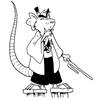
STAN SAKAI: Well, "Usagi" literally means rabbit and "Yojimbo" means bodyguard. A bodyguard was kind of like the gunslinger back in the old west days. "Usagi" is a ronin, a masterless samurai. His master was killed in a big war and that big war is the thread that holds all the stories together. I make references to that war every so often. Since his master was killed, he has become a sword for hire. It's kind of a serious funny animal adventure although there is some tongue in cheek humor. The samurai is pretty violent genre. The story takes place about the early 1600s in Japan. Usagi's real name is Miyamoto Usagi and he's kind of based on an historical figure called Miyamoto Musashi. Musashi wrote the Book of Five Rings and is kind of revered as the "sword saint."
WITTYWORLD: Was that the book that was recently translated for the Wall Street business executive crowd?
STAN SAKAI: Exactly. "Usagi Yojimbo" is a just loosely based on Musashi; after all, he wasn't a rabbit [laughter].
WITTYWORLD: In writing the stories, do you find it helps to read a great deal of books from this period of Japanese history?
STAN SAKAI: Yes, that helps. I also buy a lot of manga, which are Japanese comic books. There are quite a few Japanese comics about samurai.
WITTYWORLD: How do you produce the comic book?
STAN SAKAI: First, I do a little one page synopsis of the story. Then I break it into pages. I do about six pages on a single sheet of paper. Then I break the layouts into actual pages and then I write in the dialogue on the pages. I often have two or three endings in mind and as I'm doing the actual artwork, it kind of leans into the appropriate ending.
WITTYWORLD: Up until now, you've done smaller stories. How long will the new stories be in Usagi's own comic book?
STAN SAKAI: I've mostly done 10 page stories and now I'll be doing 20 page stories, plus an eight page backup. The first four issues will be a continuous story and will deal with a flashback from his early life.
WITTYWORLD: What advice do you have for an artist interested in the comic book art form?
STAN SAKAI: I think if you do a lot of research, that's what makes the stories unique. There's been a lot of the stories recently with ninjas, etc. but those stories often don't have the spirit. If you do the research, especially on the background, that's what makes the story different from the rest.
WITTYWORLD: There seems to be a flood of samurai and ninja comic books on the market. Does your audience notice the difference in your work?
STAN SAKAI: yes. I've been getting a lot of letters from people telling me that they really appreciate the extra time I spend. People even write to me with their own ideas from Japanese mythology. There's been lots of positive response on the books. I've also been selling a lot of original drawings [not the original comic book art]. There seems to be a new niche created here for "funny" animal type characters in both Japan and Europe. "Funny" animals have typically been looked down upon in America. Well, comic books in general haven't had much respect in America. That's not the case in many other countries where the comic book is a form of literature and any type of reading is appreciated. In the United States, it's kid stuff.
WITTYWORLD: There's a lot of noise in the comic book field about censorship now, because there seems to be a difference of opinion about who is the market for comics. Some people feel comic books can be just like other literature, for a variety of audiences. Others feel comic books are just for kids.
STAN SAKAI: The samurai genre has traditionally been pretty violent. I try to tone it down. You'd be amazed as to how much I have toned down from the Japanese. It's not very graphic. But I think that if the violence is part of the story, it's okay to put it in. I try to make the story a good story without adding violence for the sake of violence.
WITTYWORLD: The people who assume that comic books are just for little kids seem to be offended by any material aimed at a more mature audience if it's in a comic book form.
STAN SAKAI: Well, the age of the comic book readership has really increased dramatically over the past 20 years. I think the average age is late high school and even college age. It's an older audience, a more sophisticated audience.
WITTYWORLD: Unfortunately, you're still stuck with the image that comic books in America are for kids.

STAN SAKAI: Exactly.
WITTYWORLD: Do you find that there are some people, who have not been reading comic books, that give your work a try because of the interest in Japanese film artists like Kurosawa?
STAN SAKAI: Yes, I'm surprised because I have done book signings where people have told me that I've brought them back into comic books, which is staggering for me. After all, these are comic books [laughter].