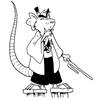
by KEN JONES (COMICS INTERVIEW #44, August 1987)
(PROLOGUE)
STAN SAKAI is exactly what you'd expect a man who spends his time fantasizing about a feudal Japanese world full of funny animals to be like. Soft spoken, modest and with a twinkle in his eye and a ready grin, Stan plunged ahead with this interview, amazed at his sudden fame. The interview took place in Stan's cozy living room filled with books, stuffed animals and original art...

COMICS INTERVIEW: I know a lot of people probably ask you this question, but when you decided to tell stories about ancient Japan and the samurai (sic) code and all that, why did you decide to use funny animals?
STAN SAKAI: (Laughter.) Well, Nilson Groundthumper and Usagi both started out as human characters. In fact, I have an eight-page Nilson Groundthumper story with him as a human and Hermy as a little troll. Usagi was a secondary character in the Nilson Groundthumper storyline. Nilson Groundthumper was originally intended to be a full-length comic-book novel, and in it Usagi dies. But anyway, I was just fooling around and changed them into animals and it took on a whole new personality. I really like them. Nilson kind of started off like... do you know the TARAN THE WANDERER series?
COMICS INTERVIEW: Yeah.
STAN SAKAI: It was kinda along that vein, but when I turned him into a rabbit he seemed to have a lot more character and he looked good, and Hermy instead of being a troll became this little . . . I haven't really quite figured out what Hermy is. He's kind of like a little potato with . . . something.
COMICS INTERVIEW: You could make it into a contest and have people guess.
STAN SAKAI: Yeah. I've called him a hedgehog, I've called him a mole, I've called him a groundhog. It never really bothered me. But anyway, going on to Usagi, when I tied up his ears I loved it. Design-wise I was really pleased. It just felt right.
COMICS INTERVIEW: Tell us some of your credits in the comic industry.
STAN SAKAI: Well, I started off as a letterer. I've been lettering GROO ever since it started with Pacific.
I've just started lettering a new series from Eclipse called KAMUI, which is a Japanese series that they picked up to translate for the U.S. market. I also letter the SPIDER-MAN Sunday newspaper strips.
COMICS INTERVIEW: Have you ever done any other lettering in newspaper strips besides that?
STAN SAKAI: I've done lettering for the strip, MR. ABERNATHY. I did the lettering for the presentation for another strip called SHERMAN ON THE MOUNT. I think it was the first three weeks. I do the lettering for the MASTERS OF THE UNIVERSE giveaway books.
COMICS INTERVIEW: I love those. My kids always give me all of their doubles. (Laughter.) They're fascinating because of the range of talented cartoonists involved with them.
STAN SAKAI: Yeah, there are a lot of good cartoonists in there. When adults hear I do the MASTERS OF THE UNIVERSE books, I get two reactions, either, "Oh! You do those!? or "Oh, you do those." (Laughter.)
COMICS INTERVIEW: About Usagi, that's been . . . well, where did Usagi start off?
STAN SAKAI: He appeared in ALBEDO #s 2, 3 and 4 and then in CRITTERS. He's also appeared in a color story for DOOMSDAY SQUAD--I think it was #3--and he's made cameos in Phil Yeh's PENGUIN AND PENCILGUIN and another cameo in a story I did for GRIMJACK #30. It was a "Munden's Bar" story. That was fun.
COMICS INTERVIEW: Let's assume that some of the people reading this interview have not seen your work yet. Why don't you tell them something about it that would interest them, about your character and about your solo book that's coming out with Usagi in it.
STAN SAKAI: The storyline takes place roughly around the turn of the 15th century in ancient feudal Japan. This is a time of turmoil. The shogun has just been established. The age of rebellion in Japan has just barely ended. Usagi is a wandering samurai or ronin. The first four issues deal with his early life. It's primarily flashbacks. In the first issue, he learns his swordsmanship and meets his teacher. The second issue deals with his first tournament and how he gained his swords. In the third issue he goes back to his old village and cleans out some unpleasantries there. The fourth issue has him serving his lord and ends with the great battle which left him a ronin.
COMICS INTERVIEW: Something that occurred to me that might be fun for you to try -- do you think there's any possibility that Usagi has descendants in modern day Japan?
STAN SAKAI: Oh, that's something I didn't think of. Maybe I could do a spin-off, a funny animal modern-day ninja/samurai story. I've just been dealing with Usagi as a character in feudal Japan. Yeah, that's interesting. Maybe I'll do it as a backup to USAGI one day.
Anyway, the character of Usagi is based very loosely upon a historical figure named Miyamoto Musashi who lived during that time and is considered the epitome of the samurai. Musashi was the author of the book THE FIVE RINGS which is now used in big corporations by executives as a guide to strategy. (Laughter.) It's very loosely based upon his early life, and of course I've taken from other sources, like all of those Kurosawa films and those Japanese movies I was brought up on.
"Usagi Yojimbo" literally translates as "rabbit bodyguard." I guess a bodyguard in feudal Japan was a position similar to a gunslinger or hired gun in the old west. The character's actual name is Miyamoto Usagi, a take off on Miyamoto Musashi's name.
COMICS INTERVIEW: You mentioned Kurosawa and Japanese films--what about your other influences? What do you enjoy reading and what are your other influences in film besides that?
STAN SAKAI: Let's see. . .I read a lot of books. As far as comics go, I read, of course, the Alan Moore stuff, which I really enjoy, and Mark Evanier's stories, which are fun. I like Mark's writing. Of course, GROO. I buy copies of GROO and give them away because I like it so much. Beyond that I don't follow any series very religiously. I pick up books here and there and I enjoy those, but I don't follow anything really close, not the way I used to.
COMICS INTERVIEW: When you were younger, what did you read?
STAN SAKAI: Oh! Of course, the old Stan Lee and Jack Kirby stuff! I grew up on Steve Ditko's work. Steve Ditko was my first big influence. I loved his old SPIDER-MAN and DOCTOR STRANGE strips. Those were great. I would buy almost all the Marvels and all the DCs. I loved those.
COMICS INTERVIEW: Is Disney an influence on you?
STAN SAKAI: Well, a lot of those Disney things around the house were given to me--given to Sharon, actually. She's the stuffed animal collector. Yeah, I guess so. I enjoyed his work. I enjoy the Gladstone series, I've been buying those. Those are great.
COMICS INTERVIEW: What I'm trying to dig back down to is your funny animal stuff. There must have been something primal or "Gee, I'd love to do funny animals someday!" (Laughter.)
STAN SAKAI: Well, Dave Thorne. . .I've always loved his work and it's primarily funny animals. I guess he was my very first funny animal influence. Before that it was always Ditko or Kirby or, you know, that type of thing. Walt Kelly, I loved his POGO work. I can't really think of any one funny animal person. There's a lot of European stuff. I think my present influence primarily is Sergio Aragones, and for inking style a European artist, Milo Manara, Sergio introduced me to Manara's work, oh, about 1980, and I've been looking everywhere for his books and things and I've gotten quite a few. Now they're being translated into English so I finally know what's going on. (Laughter.)
COMICS INTERVIEW: Speaking of translations, has USAGI ever been printed in Japan and have you received any reaction from over there yet?
STAN SAKAI: I sent off a few copies to Japanese publishers but I've gotten no reaction yet.
COMICS INTERVIEW: That's interesting. It seems like a natural.
STAN SAKAI: Well, Japan is not very much into funny animals, and whatever funny animals they do have are primarily geared at kids. It's a very small funny animal market, and I think my book is geared towards the older kids and the more mature reader.
COMICS INTERVIEW: Have you always been a fan of funny animal comics and drawing in that style?
STAN SAKAI: Not really. I started off doing more realistic illustrations, but funny animals just came naturally to me. It's a lot easier, too.
COMICS INTERVIEW: What do you see the difference is between working in black-and-white and color? Which do you prefer?
STAN SAKAI: I prefer black-and-white. I've talked to Scott Shaw! about it a lot--he prefers color--but I prefer black-and-white, I guess because you can't hide anything with black-and-white. What you see printed is what the artwork looked like. I don't like to work with tones or airbrushing or washes or zip-a-tone just because you can hide a lot of detail that way.
COMICS INTERVIEW: What do you think about the big recent explosion in funny animal comics? Why do you think that happened?
STAN SAKAI: Well, of course it started off with those NINJA TURTLES people. My stories came out at about the same time that the TURTLES came out, so I don't consider myself part of the big explosion. I'm really disappointed with a lot of the independents, the black-and-whites. It feels like they're out there just to make a quick buck.
COMICS INTERVIEW: Yeah, there is an exploitative ring to the whole thing.
STAN SAKAI: Yeah, very.
COMICS INTERVIEW: What do you see happening with the independents in the next year or so? Do you think this flood of material's going to last?
STAN SAKAI: Well, I've been hearing about the great black-and-white recession that's supposedly going on now. My editor, Kim Thompson, assures me that USAGI's going to continue.
COMICS INTERVIEW: So, do you think when the funny animal boom that's going on in the black-and-whites now dies out there'll still be a legitimate market for good funny animal stuff?
STAN SAKAI: I hope so. The way I see it, this recession is just going to wipe out the chaff and leave the good. I hope that USAGI and CRITTERS are going to continue.
COMICS INTERVIEW: You have a lot of authentic research in your work, I know that because I studied Oriental culture in college. Has this always been a fascination of yours, the weaponry and--
STAN SAKAI: Well, I grew up in Hawaii watching samurai movies and reading Japanese comic books and I've always had an interest in them, but the person who really pushed me into doing a lot of research was Sergio Aragones. For GROO, Sergio does an immense amount of research. If he has to draw a ship--that Groo sinks, of course--Sergio will go to the library and look up different research books on ships and he'll go home and make up his own design and it'll be accurate from different points of view. He'll learn everything there is to know about ships before he actually draws one. He encouraged me to do my research on USAGI, so I've got a lot of books on Japanese history, folklore, the samurai class, war tactics, folk houses and country life. I've accumulated quite an amount of research because of him.
COMICS INTERVIEW: Japanese folklore is something that would be fun sometime to have you explore in USAGI, the whole rich tradition of myth and demonology and stuff that's in Japanese folklore.
STAN SAKAI: As a matter of fact, in the fifth issue of USAGI he meets a kappa, which is a kind of Japanese water sprite, and in other issues he's going to met a few other characters from Japanese folklore--like the dragon; Yuki Onna, which is the snow woman; and a tengu, which is a mountain goblin. I'm just going to toss in these bits of mythology every so often just to keep the book more interesting. Originally, I was going to deal primarily with mythology, but after doing the first story. . .Usagi's stories just tended to go their own way and it became more a historical piece rather than a fantasy piece.
COMICS INTERVIEW: Let's talk about your creative process--what is the methodology of your work? How do you go from thought to finished product?
STAN SAKAI: First of all, I write a brief outline of the story. I usually think of a plot, mull it over in my mind--for about a month, maybe--before I set it down to paper. Then I do some thumbnail sketches. I take a sheet of typing paper and divide it into six rectangles and each rectangle would represent a page; I do the layout and write the dialogue on there and then go directly to the finished artwork. The story changes a lot when I'm actually working on it. In the first Usagi story, "The Goblin of Adachigahara," I started with four different endings: the woman was a goblin, her son was a goblin, the goblin was someone else altogether, and the one that I used was that her husband was a goblin. That's primarily the way I work.
It takes me about a half to a full day to pencil an entire page. I work pretty slowly. To ink a page it takes about, oh, three to four hours. If it's very detailed, it sometimes takes a full day. I put a lot of detail and a lot of crosshatching in my work.
COMICS INTERVIEW: There is an interesting amount of violence in your work.
STAN SAKAI: Actually, I have really toned down the violence when compared to a typical Japanese comic book. In those books heads fly, blood spurts, there's gore, guts. . .I think I've really toned it down.
COMICS INTERVIEW: Yeah, I think you have, too--although the violence never seemed offensive in the first place to me, because it seemed like part of the story.
STAN SAKAI: Yeah, it is. None of the violence is gratuitous. Each fight scene is essential to the storyline and they tend to be pretty short, no longer than absolutely necessary. There is only one instance in which Kim has suggested that I tone down a panel.
COMICS INTERVIEW: Oh, what was that?
STAN SAKAI: Well, I had sent him Xeroxes of a story--in one panel it showed Usagi cleaving open a bandit's head and there were brains flying out of his ears and the skull was flying apart, and there's blood and guts and he's spitting blood; but after I sent it off to Kim I looked at it and said, "Hey, this is a bit much." I showed it to my wife and she said, "Hey, this is a bit much." Kim called a little while later and said, "Hey, this is a bit much." (Laughter.) But by the time he called I had already whitened out all the bits of brain and had put his skull back together, so it wasn't any problem for me.
COMICS INTERVIEW: I understand you're going to be collecting those stories in some kind of MAUS-type of a format.
STAN SAKAI: Yeah, it's called the USAGI YOJIMBO GRAPHIC ALBUM SERIES and the first issue is going to be BOOK ONE. It's roughly 150 to 160 pages long in a MAUS-type trade paperback format. I did a painted cover for that.
COMICS INTERVIEW: I saw that in your studio.
STAN SAKAI: I haven't done a painting for years, and I love to paint.
COMICS INTERVIEW: This is something that's interesting because your books are fast approaching this status with USAGI--what about the concept of a hot book that's so bandied about now?
STAN SAKAI: Well, I never considered Usagi a hot character. Well, at least I didn't realize it until this past San Diego Con, where there were at times people lined up to get their books signed. At the previous two San Diego Cons we could hardly give away copies of ALBEDO, much less sell them. Now they're going for outrageous prices.
COMICS INTERVIEW: What do you think happened to cause that? Do you have any theories on why a book suddenly goes from the bottom to being worth $200.?
STAN SAKAI: Well, I know ALBEDO #1 is scarce, it's very scarce. I myself have just three copies left. I think Steve Gallacci gave me about 30 copies and I gave all of them away except for those three. At that time black-and-whites were not selling. He printed 2,000 copies and he only had enough money to print 500 covers, those are the "dull red cover" issues. After he sold those, he had enough money to print the other 1,500, and that turned out to be a bright red cover, and now it's going for outrageous prices. Usagi's first appearance is going for about $100.
COMICS INTERVIEW: Wow, that's incredible.
STAN SAKAI: Yeah. Well, I have about ten copies of that. (Laughter.) That I'm holding onto.
COMICS INTERVIEW: Sell those for $2,000, right?
STAN SAKAI: Well, it's just that they're mine.
COMICS INTERVIEW: Do you see any of your characters as potential animated series?
STAN SAKAI: I would love to see Usagi animated. I think he's made for animation, really, because I thought up his design pretty well. But I'm not sure if his stories could take animation well; especially if you talk about Saturday morning stuff, it'll never get through the censors.
COMICS INTERVIEW: I was thinking more in terms of a FIRE AND ICE type of movie.
STAN SAKAI: Oh, that'll be great.
COMICS INTERVIEW: Do you follow those type of projects?
STAN SAKAI: I would love to see Usagi done that way, as a feature film or something. That'll be super.
COMICS INTERVIEW: How about a live action HOWARD THE DUCK type movie? (Laughter.) Whack! Whack!
STAN SAKAI: Well, I've never seen HOWARD THE DUCK.
COMICS INTERVIEW: How diplomatic of you. You know, it might be interesting sometime to see Alan Moore do Usagi--
STAN SAKAI: That would be great! (Laughter.) I would love that.
COMICS INTERVIEW: I know he reads this magazine so maybe he'll jump on that. What kind of feedback do you get from people, like at conventions and all of that?
STAN SAKAI: One question I'm frequently asked is, "What are those dinosaur/lizard creatures that always appear in the stories?" Well, I, like most cartoonists, love dinosaurs, so I drew in a mini-bronotosaurus-type lizard in the first Nilson story and they've appeared in every one of my stories since then, usually in the background. They're omnivorous and act as the scavengers in Usagi's world. They've gotten pretty popular and so I'm planning a story seen entirely through the eyes of one of these lizards. In another story, Usagi takes one for a pet.
COMICS INTERVIEW: What's he going to called?
STAN SAKAI: Spot. (Laughter.) But generally feedback has been pretty positive. People say they like my work. Surprisingly people have commented about the stories, the actual writing, and I don't consider myself a good writer at all.
COMICS INTERVIEW: Oh, gee, I do.
STAN SAKAI: Oh, really? I don't. (Laughter.) That really surprised me, and they say they like the research that I've been doing. I like the character, myself, but it always amazes me when other people come up and say, "Hey, I like what you do."
COMICS INTERVIEW: That's great. When you're doing USAGI how deeply do you identify with the characters? Do they seem to be real characters to you?
STAN SAKAI: Yeah, they do.
COMICS INTERVIEW: And you can really crawl inside of that world and see everything work--
STAN SAKAI: Yeah, in fact in one issue of CRITTERS, Don Dougherty was looking through the Usagi story and said, "Hey, Usagi's beginning to look like you." (Laughter.) I didn't see it, but yeah, I really identify with the characters.
COMICS INTERVIEW: I am curious about your reaction to the censorship issue that's so hot right now. Have you been following the controversy?
STAN SAKAI: Yeah, I have. As for USAGI, I really don't know if I would like it to be under any kind of rating system or not.
COMICS INTERVIEW: If you were doing somebody else's charcters (sic), say, and they wanted to censor that, do you think that's legitimate?
STAN SAKAI: If I'm doing their characters, I think they should have a right to say what I can or cannot do--unless of course they've given me carte blanche and said I could do anything I wanted to do in the first place. Then I would take offense at that, but if it's with the understanding that I keep the spirit of their character, I don't see any reason why I shouldn't follow their guidelines.
COMICS INTERVIEW: Do you have interests in working on other people's characters or do you really just want to do your own?
STAN SAKAI: Well, I'm doing a story for the TEENAGE MUTANT NINJA TURTLES people. It's for a new book called TURTLE SOUP, where other artists create stories that feature the turtles. My story is a 6-pager, called "Turtle Soup and Rabbit Stew," and has Usagi meeting up with Leonardo, the sword-wielding turtle. I'm really having fun with that.
COMICS INTERVIEW: Having done both, are you more satisfied working from your own scripts or working with other people?
STAN SAKAI: Well, I've worked with a few others. John Ostrander wrote a story for the "Munden's Bar" thing that I did for GRIMJACK. I enjoyed working with that except that I kept thinking to myself I'd like to change the ending (Laughter.) But of course it was his script and I just followed it as best as I could, and that's happened to me a couple of other times, where I just thought, "Hey, I kinda want to change this. I should change this. I really feel I should change that." But again, it was working with somebody else's script. I could make suggestions but that was about it. Whereas for my own stories I have complete control. Fantagraphics has no input until they receive the finished story.
COMICS INTERVIEW: That must be nice.
STAN SAKAI: Yeah, and they've been very accommodating. The only times they've ever edited my work was when Kim would call up and say, "You spelled this word wrong," and that was about it-- except for the time, like I said, where the guy's head got, you know, cleaved in half. That's the only time where he's ever criticized any of my story or art.
COMICS INTERVIEW: Are you ever going to attempt to just write a story for somebody else to illustrate? Are you interest in that?
STAN SAKAI: I've never given it too much thought, but yeah, I kinda would like to. I've got a story that I would like to do--I've been thinking of doing it myself. It's a straight science-fiction piece with people, and a little bunny. (Laughter.) Yeah, that's something I may write and ask someone else to do. Someone that I've always wanted to with is Dennis Fujitake.
COMICS INTERVIEW: Oh, yeah, his stuff's excellent.
STAN SAKAI: I grew up with Dennis and Gary Kato. We grew up around the same area in Hawaii and I just love their work. We would get together every so often--this was during, oh, junior high/high school days--and show each other what we had been drawing. Of course everything was Steve Ditko influenced at that time. (Laughter.) Dennis was really heavy into Steve Ditko and so was Gary. You can see a lot of Steve Ditko in Gary's STREETFIGHTER series.
COMICS INTERVIEW: Oh, yeah.
STAN SAKAI: It's pure Ditko. But anyway, like I said, Dennis is one person I would really love to work with. In fact, Dennis is doing the backup for my first issue.
COMICS INTERVIEW: Yeah, I'd heard that, that a lot of people are contributing back-ups to USAGI. Who else?
STAN SAKAI: Well, the USAGI series is going to be 20 pages of new USAGI material plus an eight-page back-up by different artists, and Dennis Fujitake does the first back-up. It's about the Platypus/Tasmanian Devil wars and it's a tribute to Vaughn Bode. The second issue is done by Dave Thorne, who is a good friend of mine from Hawaii. He does the best funny animals I have ever seen, beautiful work. The third issue back-up is by Don Dougherty, who is coming out with his own series, BLAST. The fourth issue is by Scott Shaw! The fifth--
COMICS INTERVIEW: What is Scott going to do?
STAN SAKAI: I think it's going to be about a platypus. He's working with Mark Evanier on this, Mark doing the writing. I feel I've got pretty good people.
COMICS INTERVIEW: You bet.
STAN SAKAI: The fifth and sixth issues are going to be done by Gary Kato and it's a penguin story. The seventh issue is by Phil Yeh and the eighth issue is by Tom Luth.
COMICS INTERVIEW: Who would you like to see do back-ups that haven't?
STAN SAKAI: Well, I have enough back-ups for at least a year now and I haven't really approached any other people. Eastman and Laird, I'd love to have their turtles. (Pause.) Gee, I don't know. There's so many people I would love to have write things for me. I would love to have a story by Mark Evanier that I would illustrate, and I would love to do the same with a story by Marv Wolfman. There's so many people that I would like to work with.
COMICS INTERVIEW: A lot of people don't realize that Marv is quite a funny animal fan and has a background with CRAZY magazine and all of that.
STAN SAKAI: Yeah. Oh, another person that's doing a back-up is Sergio.
COMICS INTERVIEW: Do you have any idea what that's going to be--or is it top secret?
STAN SAKAI: I have no idea. He's so busy. I left it open to him, said whenever he had a story I'll be glad to print it.
COMICS INTERVIEW: That's something that I've always been interested in, is how much camaraderie there is among the GROO group.
STAN SAKAI: There really is a lot. I really wanted to have all of the GROO people in the USAGI SUMMER SPECIAL. Tom did the coloring for the cover, Mark did the introduction, Sergio did the pin-up page. I was really pleased with the way it turned out.
COMICS INTERVIEW: Let's talk about Sergio.
STAN SAKAI: Do you want to hear about the creative process of GROO?
COMICS INTERVIEW: Yeah!
STAN SAKAI: Okay, primarily it's Sergio's story. Sergio plots and draws it then gives it to Mark Evanier. Sergio acts out each issue of GROO in Mark's kitchen. Mark has a pretty big kitchen. He might say Groo does this, Groo does that--I've seen Sergio do that in my house and he's great! He's running all over the place and he's just fun to watch! Mark takes the pages from there and he erases all of Sergio's dialogue. . .(laughter) the reason for this is that Sergio writes the way he talks, with a very thick accent. Then Mark writes down his own interpretation of what Sergio meant to say and he gives it to me and I do the lettering and give it back to Sergio. Sergio's pencils are incredible. A squiggle with a big nose is Groo. A squiggle without a big nose could be a huge army. (Laughter.) His pencils are outrageous. You've seen my pencils. My pencils are really tight. I'm always impressed that Sergio can actually make things out of those squiggles. Anyway, Sergio finishes up the artwork and gives it back to Mark who does whatever Mark does, and from there it goes to Tom Luth and to Marvel.
COMICS INTERVIEW: You said you also work on the SPIDER-MAN newspaper strip. That must be great, after you were such a Ditko fan, to be working on SPIDER-MAN.
STAN SAKAI: Yeah!
COMICS INTERVIEW: It must be a lot of fun to know that you're lettering something that's seen all over the world in newspapers.
STAN SAKAI: Yeah! The main reason why I agreed to do SPIDER-MAN was that I would work with Stan. I've turned down a lot of lettering assignments just because I don't want to do that all my life--I want to get into more artwork--but when the opportunity came up to letter SPIDER-MAN I jumped at it. He just called out of the blue, saying, "Hi, this is Stan Lee, do you want to letter SPIDER-MAN?" So I said, "Sure, I'll do it!"
COMICS INTERVIEW: Did he call you true believer or anything while you were on the phone with him? (Laughter.)
STAN SAKAI: No. He signs all of my books and things "Excelsior" though.
COMICS INTERVIEW: Gee, that takes you back to being a kid again.
STAN SAKAI: I guess the main reason I'm doing SPIDER-MAN is because of Stan.
COMICS INTERVIEW: I know there's something missing here. How about something from your childhood?
STAN SAKAI: I used to crawl through sewers. Sharon always reminds me of my sewer days. Friends and I made homemade candles and went down the manholes and crawled through and came up in the middle of the street on a different block. I just did this a couple of times. Back then the sewers were cleaner. (Laughter.)
COMICS INTERVIEW: Stan, you and I are both members of C.A.P.S. Why don't you explain what C.A.P.S. is for the readers.
STAN SAKAI: Well, C.A.P.S.--Comics Art Professional Society--was founded by Sergio and Don Rico and Mark Evanier as a social organization because cartoonists are primarily loners. I work at home and I don't see anyone during the day, and most cartoonists are like that. They figured there are so many cartoonists in the L.A. area, we could get together, form an organization so we can just talk and shoot the breeze without publishers or anyone getting down on us. That's how C.A.P.S. was born and I thing this is C.A.P.S. tenth anniversary year.
COMICS INTERVIEW: Yeah, it is. There are some interesting people in the organization, too.
STAN SAKAI: Yes, right. Jack Kirby is a member. I think for one year Stan Lee joined, too.
COMICS INTERVIEW: Is that right? I didn't know that.
STAN SAKAI: Well, I'm not sure. His agreement was, "I'll join if I don't have to attend meetings." (Laughter.) You know, I work with Stan now and that's the kid of guy he is. Yeah, Stan would say that.
COMICS INTERVIEW: Do you have any ambitions in the future to ever try to get your feet wet doing some other genre?
STAN SAKAI: You mean besides just doing funny animals?
COMICS INTERVIEW: Yeah. You already mentioned the science fiction. If DC approached you and said, "Gee, it'd be great to have you do a fill-in issue of TEEN TITANS," would you?
STAN SAKAI: Yeah, I think I would. But like I said, I don't consider myself a good writer. I think I'm able to get by. Whenever I'm stumped in a storyline I think, "What would Mark Evanier do about this?" (Laughter.) Really, I've done that a couple of times. I'm sure Mark would never do the types of things that I came up with. I don't consider myself a good writer, but then if the opportunity arose for me to do a story like that, sure, I'd jump at it.
COMICS INTERVIEW: How would you approach a superhero story? What would be the difference between doing the kinds of stories you do now? What do you think the process would be?
STAN SAKAI: Well, first of all, all their ears would be tied up. (Laughter.) I have no idea. It's something I've never thought of and I'd have to really think about something like that.
COMICS INTERVIEW: What would you like to accomplish in the next ten years professionally?
STAN SAKAI: Well, hopefully ten years from now USAGI will still be going on, because I really look forward to working on USAGI. I wake up in the mornings saying, "Hey, I'm going to do this!" Aside from that I would love to get another character going, maybe a space strip or something. Again, funny animals maybe, because I enjoy doing funny animals now.
COMICS INTERVIEW: Well, do you have any final thoughts--you have people here that you're speaking to all across America and Europe and everything, what can you tell them that would make them want to go out and seek out your work out of the other 600 titles?
STAN SAKAI: I don't now. I enjoy it. (Laughter.) I like reading my stories over and over again. I think it's suitable for rereading. There's so many people today who just collect comics, there's not enough people who actually read them, and I think my stories are very readable.
COMICS INTERVIEW: That's what's wonderful about GROO, that people don't put it in a plastic bag, they actually read it.
STAN SAKAI: I do the lettering and I'm always going back and rereading GROO and looking for those hidden messages. Sergio's been drawing all of us, you know, doing cameo appearances in each issue of GROO. I think last issue I had a helmet with these bunny ears tied to the top. (Laughter.) I thought that was great. But yeah, again, there's too many collectors and not enough readers, and I think USAGI's a comic that you can go back to and read again and again.