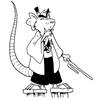
by GIL JORDAN (AMAZING HEROES #187, JANUARY 1991)
Okay, so the Teenage Mutant Ninja Turtles are THE most unlikely comic success story of the late '80s. But the award for SECOND most unlikely must surely go to Stan Sakai and his Usagi Yojimbo, a funny-animal samurai strip that manages to combine the goofiness of Groo with the high drama of The Seven Samurai -- sometimes within the framework of a single story.

High concept aside, the success of Usagi Yojimbo should come as no surprise to those diehard fans who, a half decade ago, picked up a copy of Stephen A. Gallacci's Albedo #2 and discovered the first installment of what would become a sweeping epic of feudal Japan. (Stan will turn in his one thousandth page of Usagi sometime in 1991.) Because even that little eight-page vignette, featuring an unsmiling and oddly compact a character to reckon with: Stan Sakai, a peerless master of design and continuity, and Usagi Yojimbo, a dynamic, noble, yet endearing hero.
Usagi blazed his way through a couple more issue of Albedo, and then became one of the starring features in Critters; a popular Summer Special and a year later, the long eared samurai was awarded his own regular comic -- and comics stardom was his. As we now go to press, Stan is busy working on the 30th issue of Usagi; meanwhile, the fourth volume of the collected Usagi is just reaching the stands, and Stan's colorist- of-choice Tom Luth is busily labouring over the 1991's second Usagi Yojimbo Color Special.
Aside from his solo work, Usagi has set up a happy partnership with the aforementioned Mutant Turtles: he's guest starred in two episodes of the TV show, has teamed up with a turtle or two in various comics, and is part of the "TMNT Action Figures" line (Albeit in a severely mutated shape). In this interview, Stan Sakai talks about his influences (surprising); his work habits (remarkable); his friends in the industry (numerous); the origins and future of Usagi (astounding); his work as the letterer of Sergio Aragones' Groo (hectic); his web line (Advantageous -- oops, got carried away there for a moment); and much more. It was conducted by Gil Jordan, Transcribed by Tom Harrington, *originally* and edited by Kim Thompson... and will now be read by you, the discerning reader. – (Introduction by Kim Thompson)
AMAZING HEROES: What kind of work were you doing before you started doing Usagi regularly?
STAN SAKAI: Before starting Usagi I worked as a freelance artist around the L.A. area. I did advertising, book illustrations, record albums, stuff like that -- nothing really important. But I also taught calligraphy and because of that Sergio [Aragones], whom I've known for years and years now, asked me to letter his new comic, Groo the Wanderer. That was my first foray into legitimate comic books. Before then of course, I used to contribute to fanzines and APAs -- whatever you call them now.
AMAZING HEROES: How long before Usagi actually appeared [in 1985] did you create him?
STAN SAKAI: Interestingly enough, Usagi did not start off as a funny-animal series. It was kind of a historical book with real people in it, based on the life of Miyamoto Musashi, who was a 17th Century samurai. One day I just created a rabbit, and changed his name from Miyamoto Musashi to Miyamoto Usagi -- bit I tried to keep the feel of the chambara [swordplay] comics, the Samurai comics, and I tried to keep it historically accurate -- within reason.
I've got Usagi sketches dated about 1982 -- Nilson Groundthumper actually predated Usagi by about a year or so. But the early Usagi looks nothing like the present-day one. For one thing, he had a fringe of hair around his head, and he had heavy brows, kind of like what Nilson has now. Also, he was pudgier, darker looking. I kind of streamlined him when he made his first appearance, in Albedo #2.
AMAZING HEROES: Even after that, though, his design's evolved...
STAN SAKAI: He's constantly changing. When he originally appeared he was four heads tall; now he's more like five heads tall. And in the past couple of years he's developed a bump for his nose in profile. Before, he never really had a nose in profile.
AMAZING HEROES: Are these changes a conscious decision on your part?
STAN SAKAI: Usagi just changes on his own. I noticed in, I think it was issue #5, that suddenly he was a little taller, a little more streamlined: that was completely unconscious on my part. But I kept him that way now. When I look at his earlier appearances, he looks a bit too chubby, a bit too cuddly. This might also be because of the type of story I've been writing. It's more dramatic now, rather than humorous, and I think the sleeker, taller appearance works better with a dramatic story.
AMAZING HEROES: There is a complex interplay between comedy and drama in Usagi -- it seems to move from one extreme to the other.
STAN SAKAI: Well, Usagi's always had a really broad range of humor or drama. I never consciously set out to create a humorous or dramatic title; I just wrote the stories that I like to do. Sometimes they're humorous, sometimes they are dramatic, and Usagi's been comfortable in the entire range. It's nothing conscious on my part. I think that Groo is definitely a humor title, but Usagi can be both, which I love because I can write almost any type of story that I want to within the genre.
AMAZING HEROES: Usagi is a comic that appeals to a wide range of ages, including little kids. Do you worry about the level of violence in the comic?
STAN SAKAI: I'm not that concerned about it, primarily because I don’t think I put in any gratuitous violence in the story, and whatever violence I do put in is pretty tame compared to other comics that are out there. I don't do blood spurting out all over the place. Actually, there aren't that many dead bodies in Usagi [laughs]. There is a fair amount of violence, but it is subdued. I keep it within reason: Whatever I feel comfortable with, that's what I put in.
[Akira Kurosawa's] Yojimbo, for instance, is a great movie. There is a lot of violence, but you never really think about it. But then, the Samurai movies in general are very violent, with their famous "death in slow motion" scenes -- when jugulars get hit it's like a hose spurting out of the neck. I've really kept Usagi pretty tame compared to that.
AMAZING HEROES: What's your favorite samurai movie?
STAN SAKAI: Oh, I love The Seven Samurai. I think that's probably the best movie ever made. The storyline... the cinematography is great, the characters are wonderful. [Toshiro] Mifune's terrific in that movie. It's been remade a couple different times as a western [The Magnificent Seven] and even as a science fiction movie [Battle Beyond the Stars]. Nothing ever quite as good as the original, though. Kurosawa's a genius. Actually, I'm influenced more by the movies than I am by comic books. I try for that epic scope that Kurosawa achieved and I think more as a filmmaker than as a comic book artist. I try to make the panels of the story flow more like storyboards than a regular comic book. You see, I don't really read that many comic books -- but then I don't go to that many movies either.
AMAZING HEROES: How familiar with Japanese comics are you?
STAN SAKAI: I'm not really that into manga. It's funny: whenever I go to conventions around the country I'm always put on a manga panel, I guess because I'm Japanese and Usagi's about Japan. But I know almost nothing about manga. So I just say my two cents' worth and keep quiet the rest of the panel.
AMAZING HEROES: You're part of the Hawaii mafia of cartoonists....
STAN SAKAI: Oh, with Dennis Fujitake, Gary Kato, and Dave Thorne? I grew up with Dennis and Gary. We all lived in roughly the same neighborhood. So I knew them when I was in eighth grade or so. Actually, they're the ones who really got me turned on to comic books. I had collected them before but never with the intent of going into the business. In fact, before meeting them I never consciously thought that there were people out there producing comic books. I just thought they magically appeared on the shelves every Friday or so. But after meeting [Gary and Dennis] we really got into artwork and story. And oh, we worshiped Steve Ditko. This was when Ditko was doing Spider-Man, about #18 or so. We were all Ditko clones. All our poses were like Ditko's. Ditko was wonderful; he still is. It's funny how our styles have changed so much now. We all had the same starting point but our styles are completely different. I guess Gary Kato is the one that has kept the Ditko influence the most.
If we talk about Hawaii we have to talk about Dave Thorne, who was kind of like the cartoonist guru in Hawaii. Dave pretty much gathered or created a cartoonists' organization in Hawaii, and by doing that, we got to meet other cartoonists and got to evolve our styles, and also a cartoonist's marketplace in Hawaii. Dennis still does a lot of local cartooning there: T-shirts, advertising art, and such. Gary's a freelance cartoonist there too.
AMAZING HEROES: Which cartoonists would you consider your major influences?
STAN SAKAI: I guess Steve Ditko was the first real influence. Lately, of course, it's Sergio, because I work with him so closely and I see the way he works and I see his influences. Let’s see.... inking style: I like Milo Manara. Sergio showed me some of his work and I fell in love with it. Beautiful line work. Those three I think are the biggies. Funny, though, you can't really see their influence in my work, I think.
I love Moebius's work and there are a lot of artist's whose work I really enjoy but I don't think I've really consciously incorporated their styles into mine -- like Jack Kirby, Almost everyone's been influenced by Kirby. There's also Bill Stout, who's a friend of mine whose compositions are great -- great artwork. There's so many. Of course Carl Barks, too.
AMAZING HEROES: Most of your work appears in black-and-white rather than color. Is that a matter of aesthetic choice, or of economics?
STAN SAKAI: It's mostly a matter of choice, though it is a bit of a matter of economics. But colorists in America really don't know how to color. They either try to hide bad artwork or they oftentimes wind up hiding good artwork. They don't push it to the limit like they do in Europe. In the United States grass is always green, the sky is always blue -- American audiences have a very literal color sense. There are just a few colorists in America who really know how to color. Tom Luth, of course, is one. Anyone who can color Groo is terrific [laughs] and he's my colorist of choice whenever we do a color special or color covers. Lynn Varley's another one; terrific color sense. There's a new book out from Disney, White Fang, colored by Christine Schearer, and she's terrific; the coloring looks great.
AMAZING HEROES: When you get Tom's coloring back on your covers or stories, are you ever surprised?
STAN SAKAI: I'm always surprised [laughs]! No, I'm not. I trust Tom explicitly. What color instructions I give him are things that he would not know about: For example, the second color special involves a few mythological creatures such as a Tengu, which is a Japanese mountain goblin. A Tengu is traditionally red with green clothing, and of course Tom would not know about that so I did some color instructions for that. Also I indicated a few places where I wanted a specific type of effect, like a sunrise effect and an evening effect -- but as far as the other color, it's completely up to him.
I was really surprised at how well the first color special came out. I loved opening up the book and seeing that first page. Tom did a great job on that. Actually, that's the type of work that almost any colorist could do, but their page rates are really bad, so I don't wonder why Marvel and DC have such poor coloring jobs. Also, their printing's terrible. I like Art Adam's work, and I try to buy whatever Art Adams does, but Marvel has never printed an Art Adams story well yet.
AMAZING HEROES: Comico's Gumby special looked very good....
STAN SAKAI: Oh, I loved that. But again, Marvel's X-men books have all been terribly printed. The Groo books have too, I think, especially the first graphic novel. Tom did a terrific job coloring that and the printers just mangled it. It was terrible.
AMAZING HEROES: Groo is semi-notorious for always skirting deadlines. How're you doing these days?
STAN SAKAI: [laughs] Actually we're gaining ground. At one point, we were very close to deadline. When Groo left Pacific, there was a period of maybe six months before Epic picked it up. (Of course we did the special for Eclipse in that time) But during those six months we all just kept working on Groo because we knew that Groo was going to be picked up by another publisher. So the week after contracts were signed Sergio sent them one completed issue; then a week went by and Sergio sent them another completed issue, and another week went by and Sergio sent another completed issue. So they had three issues in house, and another week went by and.....nothing, so they sent us a note saying "Where's the next issue?"
But now, because of Sergio's schedule we've fallen a bit behind and are barely meeting deadlines, but we are catching up. Sergio does so many book signings. He's the only one I know who has gone to Europe for a weekend for a one-day appearance and flown back again. When we did a book signing together in Hawaii he just spent a day in Hawaii and flew back again. A lot of it is travel time, but he does take his pages wherever he goes. He's done Groo pages in Switzerland, Turkey, Tahiti; a lot of times he writes down the name of the city in the bottom right hand corner of the page so you have sort of a Groo travelogue. I think in one issue of Groo there was Heathrow, a couple of places in Ireland, Turkey, a couple towns in Yugoslavia, down in Mexico -- he's a world traveler all right.
Also, Mark [Evanier]'s really busy with his television work. He's head writer for Garfield and he's also writing a few other series. Sometimes he's a little behind schedule too. So it always falls to Tom and myself to try to get the work done as fast as we can.
AMAZING HEROES: What's the closest scrape you've has so far?
STAN SAKAI: Well, there's been times where I would have to turn over an issue in a day. I remember once when Sergio had just flown back from Europe and was going off to Mexico about four days later, and I was going on vacation to the Grand Canyon the next day. I had to drive over to his studio, pick up the pages, drive back home, do about half the issue that afternoon, mail it off to him and he got it right before he left for Mexico. But it's always fun. I enjoy working with Sergio, Mark and Groo -- Uh, Sergio, Mark and Tom, rather.
AMAZING HEROES: [laughs] I don't know how Tom will feel about that particular slip of the tongue.
STAN SAKAI: [laughs]
AMAZING HEROES: You're one of the tiny handful of cartoonists who are not only on schedule, but are actually month ahead of it. Why is that?
STAN SAKAI: I don't know [laughs]. I just keep working on Usagi...but then I rationalize it by thinking to myself that, well, if another project comes along then I can put Usagi aside for a couple months and work on something else, or if I want to take a month off I have that option. And actually, there have been a few other projects that have come up in the past few months, so I have not really worked on Usagi for about two months now -- but I think I'm still about four months ahead of schedule. I also did the Summer Special during that time, so that was done about four or five months ahead of deadline -- but a lot of that was because I wanted to give Tom as much time as I could to do the coloring.
Also, I came up from the ranks of advertising, where you always meet your deadlines. I have never missed a deadline in which it was my fault. I've always held deadlines to be absolute.
AMAZING HEROES: What are some of these other projects you've been working on?
STAN SAKAI: A lot of it has been for Disney. I just finished lettering a couple books for Disney. Right now I'm working on doing lettering and touch-up for The Great Mouse Detective. I finished a cover for, oh, Donald Duck I think. It's the first time I ever drew the duck. Also, a six-page story for Dennis Mallonee's Flare, which was a strange little piece -- a story about a stick boy.
AMAZING HEROES: Reading Usagi, one gets the impression you do a lot of research.
STAN SAKAI: Oh I do as much research as I can. I have a pretty extensive reference library at home, and again, I try to make it as authentic as I can, within reason. There are a few minor things, such as sandals, that I use a lot of artistic license on, but as far as the big things -- The code of the samurai, Bushido, houses, and the general culture -- I try to get it as accurate as I can. In fact one of my very favorite Usagi stories was the kite story [UY Vol. 1 #20], and that actually took about two years to write just because of all the research involved. It started out as a grain of an idea when I bought a book on Japanese kites. It dealt with a kite festival, so I figured, "Oh, it'll be terrific to have a Usagi story based on the kite festival." I did some research and I found out how kites were made in that time, so I created a story from three different viewpoints; the kite maker, a gambler who was in town during the kite festival, and Usagi. I integrated all three elements into one story and I was really pleased with the outcome.
Also, a lot of characters are based on historical figures. Usagi, like I said, was based on Miyamoto Musashi. Tomoe Ame, the female cat warrior, was based upon Tomoe Gozen, who was a female warrior famed for her beauty and her skill with the lance. She's an interesting character. There's not that much written about her, but I think she lived during the time of the Heike Wars, and her husband was a famous general who eventually committed seppuku but refused to let her die with him because he would have lost face if he was to die with a woman. So she eventually became a nun. Lord Hikiji, around whom a lot of stories revolve, is based upon Date Masamune, who lived around the turn of the 17th century, and he was one of the most powerful lords in feudal Japan. He too wanted to become Shogun, but he never did. Interestingly enough, he sent the first Japanese emissaries to Rome to meet the Pope, and it was a mission that ended in failure. But he was one of the most powerful lords of feudal Japan.
There are a lot of other characters that I took from Japanese movies. There’s a movie theater down the street from where I lived as a kid and I used to go there every Saturday because they showed Japanese movies. Zato-Ino, the blind swordspig is taken from the blind swordsman, Zatoichi. He had a very unusual fighting style and he appeared in a TV series as well as 27 films. (Rutger Hauer starred in a movie that was based upon those films a couple years ago called Blind Fury, but I haven’t seen it). Of course I used "Lone Goat and Kid" from Lone Wolf and Cub. Gen the bounty hunter is a tip of the hat to Toshiro Mifune's Yojimbo character.
AMAZING HEROES: Right, from Yojimbo...all the way down to the way he scratches himself all the time.
STAN SAKAI: His scratching himself, his five o'clock shadow, and also the way he kind of manipulates people and things.
AMAZING HEROES: When you're doing funny-animals, do you come up with a character and decide which animal to make him, or do you create a design based on a certain animal and then evolve a character from that?
STAN SAKAI: I do it both ways. I chose a rhino for Gen just because I kind of like the massiveness of the rhino...and he looks great with a five o'clock shadow. It looks so distinctive. Other times I've created a character or design and evolve a persona around that character. Like Jei, the demon possessed spearman. I created a design for him first and thought, "Wow, what a great looking character." So I made a story based on that design. Jei appears again in the four part "Circles" storyline that I'm working on currently.
AMAZING HEROES: To what extent do you use the characteristics that people impute to certain animals? For instance, if you have a lion he's going to be noble, if you have a dog he's going to be loyal. Do you ever try to work against that or do you try to work with it, or do you just try to ignore it?
STAN SAKAI: Well, Usagi is a sword wielding bunny rabbit...
AMAZING HEROES: [laughs] Personal valor is not the first trait that springs to mind when you think of a rabbit.
STAN SAKAI: The only time I've ever actually tried to use the animal characteristics for the character is when I created Lord Mifune, Usagi's original Lord, and I wanted someone that was noble and strong, so I used a tiger for him. But I think that is the only time I did that.... Oh, another time: Katsuichi, who's a lion. Again, I wanted someone strong and very proud.
AMAZING HEROES: I guess it would be sort of hard to have a noble weasel or a daring, dynamic turtle. [pause] Umm, bad example there, come to think of it.
STAN SAKAI: Right [laughs]. Well, a lot of the minor characters I use are generic animal shapes. They aren't animals per se.
AMAZING HEROES: Like Carl Bark's pig/dog creatures.
STAN SAKAI: Yeah, yeah, exactly. Throw away secondary characters like village people, miscellaneous bandits, atmosphere people.
AMAZING HEROES: I always thought your monkey characters looked a little weird -- like they were too close to human.
STAN SAKAI: [laughs] You mean the woodcutters? Well, that started off as a joke. Whenever I needed woodcutters I always brought them in, and they seem to be popping up all over the place. They've probably appeared in more Usagi stories than anyone else, and they were never, ever part of the stories themselves.
AMAZING HEROES: Didn't you at one point almost make them human?
STAN SAKAI: [In the penciled version of the first story] They were human. Actually, I think I've used humans in the Usagi stories about four times, and, well, humans are animals too. What can I say?
AMAZING HEROES: I guess one of the most asked questions that you get is: When's there going to be a Usagi animated cartoon?
STAN SAKAI: Well, Usagi's been on a couple episodes of the Teenage Mutant Ninja Turtles show. One episode was titled "Usagi Yojimbo". The other was "Usagi Come Home".
AMAZING HEROES: Those aren't on tape, are they?
STAN SAKAI: I don't think so, but since we're talking about the Turtle link-up here, there's the Usagi action figure, and were working on a couple more licensing deals independent of the Turtles. I can’t really talk about them because the deals haven't been finalized. But there has also been a Usagi computer game which was developed in Australia and released in Europe but evidently never made it to the United States. There were also a few Usagi T-shirts and a print, but that's about it.
AMAZING HEROES: So how would you feel about having a full-length Usagi animated feature?
STAN SAKAI: Well, if it's done right I'd love it. I really enjoyed seeing Usagi on TV. It was great. Also, the people who did the animation are fans of Usagi, so they used my character design rather than the toy, because the toy looks completely different. I love it, but it's not my Usagi, and I'm comfortable with that.
AMAZING HEROES: Every issue of Usagi has a back-up by another cartoonist and you're sort of in charge of that. How do you choose who goes in there and what they do?
STAN SAKAI: A lot of those chosen are friends of mine or people whose work I really enjoy. We've had quite a few.... Dennis Fujitake, Sergio Aragones, Dave Thorne, and Gary Kato of course. Scott Shaw did one. He's doing a two-parter for me, a mystery, in an upcoming Usagi. Don Dougherty, Jim Engel -- whose work I really love -- is going to do an issue. Ken Mitchroney, and Tom Stazer has done a bunch, and I really enjoy his work. I think I've booked up those stories until about issue #37 or so. I'm not taking any more stories right now. A lot of the reason is that I want to do some of the back-up stories myself now [laughs]. I wouldn't mind doing a few short stories with Usagi or other characters.
AMAZING HEROES: And, of course, there's always Nilson Groundthumper.
STAN SAKAI: Yeah, I love Nilson. I love Hermy, actually. He's probably my favorite character.
AMAZING HEROES: I know they're appearing as the back-up in the Color Special again. Are they going to be appearing again after that?
STAN SAKAI: Not for a while. I have a whole bunch of Nilson & Hermy stories that I would love to do, but I just do not have the time right now. Also, there's really no place for them to be published in the near future. Interestingly enough, the Usagi Color Specials have their own storyline and their own sense of continuity different from the black and white stories.
AMAZING HEROES: Sort of like dailies & Sundays in the comic strips.
STAN SAKAI: Yeah, exactly.
AMAZING HEROES: Speaking of which, I understand that you've been lettering the Spider-Man strip for a while.
STAN SAKAI: Oh, yeah, Stan Lee called one day and said, "Hi, Stan Lee here. You want to letter my strip?" So we got together and I've been lettering Spider-Man for five or six years now -- Sundays only. I really enjoy working with Stan. He's a nice guy. Also, Stan's probably the first name I associated with comic books. I grew up with his name, and to actually meet him and find that he's really a nice guy -- it's funny, he's exactly the way he's hyped up to be, which surprised me. He's terrific. I've enjoyed working with him for these past few years.
AMAZING HEROES: And you also got to meet the living legend, Alexandro Jodorowsky.
STAN SAKAI: Oh, yeah, he wrote the introduction to my fourth book. I had heard from a couple of sources that Jodorowsky liked Usagi, so I said, "Oh, that's really nice," because I've always liked his movies. And one day I got a phone call: Hi, may I speak to Stan Sakai? This is Jodorowsky." Oh wow! [laughs] He was passing through Los-Angeles from the Japan premiere of his new movie, Sante Sangre, and he was in town for a few days so we got together for dinner with Jean-Marc and Randy Lofficier. He's really a nice guy -- not what I pictured him to be, He's a real gentleman in the European sense, a marvelous person, very interesting to talk to. The only thing I knew about him was from his movies, Holy Mountain and El Topo, and he's not as wild as that. He's very nice.
AMAZING HEROES: Well, he's aged a little since then, too.
STAN SAKAI: Yeah, that's true.
AMAZING HEROES: Although Sante Sangre's still pretty wild.
STAN SAKAI: I haven't seen that yet. It never really played around here.
AMAZING HEROES: I thought it was terrific. You're starting up another epic-length story, which I guess is going to end up being the second longest Usagi story ever, right behind "Dragon Bellow".
STAN SAKAI: It's a four-issue story called "Circles" in which Usagi goes back to his home village, and it's probably the most emotional storyline I've ever done. For one thing, there's the Usagi-Mariko-Kenichi love triangle. Mariko is the old love of his life, and Kenichi is his old boyhood enemy. I'm going to tie up a bunch of loose ends. Actually, this story was thought up when Usagi first appeared in Critters #10-11, the "Homecoming" issues, but I just put off doing it until now. For one thing, I didn't feel the time was right.
Usagi goes back to his old village, but before getting to his village, he makes a pilgrimage to his sensei's grave and finds out that his sensei's still alive. There's a lot of flashbacks in this story, such as the last time he had seen his teacher and a couple of romantic interludes. The title of the storyline is "Circles" because everything gets wrapped up at the end everything is part of a huge circle. Things turn around wind back up where they were before. Anyway, when Usagi goes back to his home village, he finds that it's beset by bandits and Jotaro, who's Mariko and Kenichi's son, is kidnapped, so Usagi and Kenichi and some villagers go after them. Jei, who is possessed by the gods, is lurking around with the bandits. Usagi confronts him once again.
AMAZING HEROES: When you're planning to do a really long story like that, how closely do you have it figured beforehand?
STAN SAKAI: I have a general idea of the plot and I kind of know what each issue's going to be about, but it's not until I'm actually working on that issue that I know exactly what's in it. It's hard to describe. I have a strange way of working. Because I do everything myself I can afford to be flexible. I don't have a script per se, I just use little thumbnail sketches and I change a lot of it in the final drawings. But I have a general idea as to how far each issue goes as far as the storyline is concerned, and I just kind of wing it from there.
AMAZING HEROES: Any plans beyond that? I guess it's going to be going to short stories for a while again?
STAN SAKAI: Short stories for a while. There have been a few letters asking about the origin of Gen the bounty hunter. That'll probably be a two-issue story, so it'll wait for a while. I like to do a few short stories and then, every six issues or so, do a longer one.
AMAZING HEROES: Who are the most popular characters in Usagi?
STAN SAKAI: Besides Usagi, it's a toss-up between Gen the bounty hunter and Tomoe, and probably Spot, Usagi's pet lizard -- but Spot's already dead now.
AMAZING HEROES: How much outrage did you get when you killed Spot?
STAN SAKAI: The issue in which he died was issue #18. I had kind of alluded to his death in #17; #18 came out at the San Diego Con, and people were coming up to me and saying, "Oh, wow, Spot's still alive! I'm so glad!" And the next day they came back and say, "You bastard, you killed him off!" So yeah, I got a few letters and a few responses at the conventions about Spot, but Spot is dead. He's not coming back. Actually, I created Spot just so that he could die. "The Dragon Bellow Conspiracy" ran from issue #13 thru #18 and issues #7-12 were short stories kind of gearing up for that by introducing and re-introducing characters that would be instrumental in that storyline. Spot was introduced in issue #7. Actually I had thought I'd keep him around a while, but then I found Spot to be a liability as far as storytelling was concerned, so I had Spot go off with Zato-Ino the blind swordspig, just because it was difficult to write stories around Usagi with Spot hanging around.
AMAZING HEROES: If you'd have been writing and drawing Batman you would have killed off Robin after a couple issues, huh?
STAN SAKAI: Oh, yeah, I'd just wait for the telephone poll to come in and kill him off regardless.
AMAZING HEROES: [laughs] Well, I think that's what they did anyway.
STAN SAKAI: It seems like it. Supposedly the votes were so close.
AMAZING HEROES: So what's this I hear about Usagi going into space?
STAN SAKAI: Well for the past couple of years, I've been fiddling around with other stories that Usagi could possibly appear in, such as "Space Usagi", so I created a line of Usagi descendants, one of which is Terry Miyamoto, a 20th century descendant of Usagi who's an investigative reporter. I've been serializing one of her stories, "Ten Little Critters", in Rowrbrazzle, which is a funny-animal APA. It's a whodunnit based on Agatha Christie's "Ten Little Indians". A bunch of reporters get summoned to an island and of course they are all dying off one by one. I intersperse clues throughout the entire story and by the end of the series if you're observant you should be able to logically deduce who the killer is. So I'm having fun with that.
And since you brought up Space Usagi, that's another descendant of Usagi. The descendants I chose are those who actually own his swords. That's the link. With Space Usagi I have a lot of fun drawing weird aliens and other worlds and things. I've never actually done a story with Space Usagi yet, but I hope to.