by BRIAN KAYA (RAFU SHIMPO MAGAZINE VOLUME 1 #3, JUNE 5, 1998)
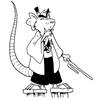
He is a paragon of the feudal-Japan samurai. He lives by a strict code of honor, bushido. He fights for justice, protecting the innocent. He treats all, from peasant farmer to fellow samurai, with the same respect and courtesy. He.... He's a rabbit? A samurai rabbit?

Yes, a samurai rabbit, the brainchild of artist/writer Stan Sakai and hero in the on-going comic book Usagi Yojimbo. The story of Usagi Yojimbo begins in Kyoto, Japan, with the birth of his creator. A couple of years after Stan's birth, his father, a Nisei serviceman stationed in Japan, and his mother, a Japanese-native, moved Stan and his brother Kenneth to Hawaii.
Twenty-two years later, with a B.F.A. from the University of Hawaii, Stan flew to Los Angeles, where he continued his education at the Pasadena Art Center College of Design. He supported himself and his wife, Sharon, by doing book illustrations, magazine advertising, and record album covers as a freelance artist. But comic books were always his dream.
Currently, Stan resides in Pasadena, California, with Sharon and two children, Hannah and Matthew. Having been a Usagi Yojimbo fan for the past decade or so, I discovered that Stan is very much like his rabbit hero, a humble soul who's nice to everyone, without the ears or swords.
Stan remains modest despite the success of Usagi Yojimbo. Usagi Yojimbo has earned Stan the 1991 Parent's Choice Literary Award, plus two Will Eisner Awards in 1996. This year, he was one of three North American comic book artists selected to attend the 4th Annual Tezuka Studios Seminar, which took Stan back to Japan for the first time since leaving.
RAFU SHIMPO MAGAZINE: Was Japan everything you thought it would be?
STAN SAKAI: Yeah, it was. Sharon and I were amazed at how polite and friendly everyone was, and how clean the cities were. We rode the subway and the trains. It's so easy it was to get around. We walked around on our own and got lost a couple of times. We saw this great "Godzilla" statue, and went to a toy store with three floors of toys. We also made a pilgrimage to the Tokugawa Shrine and toured the Edo/Tokyo museum, which shows life in feudal Japan. I shot a lot of video, some of which is starting to appear in Usagi's stories.
RAFU SHIMPO MAGAZINE: What was this seminar all about?
STAN SAKAI: The seminar is named after Tezuka Osamu [creator of Astro-Boy and Kimba the White Lion]. It was started four years after his death. It's supposed to be a seminar, but in reality, it was an all-expenses-paid-vacation! We were treated very well.
We [Lynn Johnston of For Better Or For Worse, and Erik Larsen of "The Savage Dragon,"] met with comic book publishers, editors, artists, and writers from all over Japan. It's an opportunity to meet and learn about each other and the comic book industries of both countries. I feel really honored to have been invited.
RAFU SHIMPO MAGAZINE: Is Usagi popular in Japan?
STAN SAKAI: No, not really. In fact, I was surprised that anyone even knew who he or I was. There are a few Usagi fans there.
RAFU SHIMPO MAGAZINE: So, who is Usagi Yojimbo?
STAN SAKAI: Usagi is a ronin, an unemployed samurai. His adventures take place in Japan during the Tokugawa Shogunate. This was an interesting period in Japan's history because the civil war has just ended and a new shogun has taken power. Without any wars to fight, there are a lot of ronin wandering around Japan. Some ronin became bandits because the only skills they had were with the sword. Usagi hires himself out as a yojimbo, a bodyguard.
RAFU SHIMPO MAGAZINE: How did you create him?
STAN SAKAI: I originally wanted to do a historical comic book series based upon the life the 17th century samurai, Miyamoto Musashi. One day I drew a rabbit and tied his ears up, like a samurai's topknot, and I loved the design. So instead of Miyamoto Musashi, he became "Miyamoto Usagi" [Usagi Yojimbo is the Japanese word for rabbit].
RAFU SHIMPO MAGAZINE: What are your influences for Usagi Yojimbo?
STAN SAKAI: I saw a lot of samurai movies as a kid in Hawaii, so of course [Akira] Kurosawa's films, especially with Toshiro Mifune, are a big influence. He [Mifune] was wonderful. Also Eiji Yoshikawa's book about Miyamoto Musashi. I do a lot of research. My library is overflowing with books on Japan and samurai movies on video.
RAFU SHIMPO MAGAZINE: How did you get your start in the comic book business?
STAN SAKAI: I was teaching a calligraphy class and Sergio Aragones [see sidebar] asked me if I would letter his new comic book, Groo the Wanderer [Pacific Comics version]. I had never lettered a comic book before, and even before I worked on his book, Sergio was telling everybody what a great letterer I was. We've been friends ever since.
RAFU SHIMPO MAGAZINE: Do you consider yourself a role model?
STAN SAKAI: [He laughs uncomfortably.] I, uh.... Five years ago, I would've have said, "No." But my wife insists, "You ARE a role model so when you meet people you should be nice." I meet a lot of Japanese-Americans at festivals like Nisei Week, so I try to think of myself as one.
RAFU SHIMPO MAGAZINE: Comic books are not a "traditional" career choice for Asian-Americans, but their number is growing in the field. I stink at math, which is why I became a writer....
STAN SAKAI: Well, I stink at math too. My dad told me, "You can't make a living as a cartoonist. Why don't you go into accounting or computers." I wondered, "Should I go into business?" But, no, I couldn't do that.
It was gratifying when I went back to Hawaii for my first [Usagi Yojimbo] book signing. It was crowded. There were kids everywhere. My Dad said, "Okay, I guess you can make a living...."
But, yeah, cartooning is a very risky career choice. Parents want their kids to get a secure job. Cartooning is very if-y. It's hard to make a real living as a cartoonist. Like acting or singing, the arts.
RAFU SHIMPO MAGAZINE: How do you address the violence issue in Usagi Yojimbo?
STAN SAKAI: There's a lot of violence inherit in the genre, samurai stories. It was a violent culture back then. I try to keep the violence within reasonable boundaries. I never put in gratuitous violence.

At first my wife would be my censor. But since the kids arrived, she doesn't read Usagi as much. Now I pretty much censor myself. My arrangement with my publishers is that they publish whatever I send them, so there's an additional bit of responsibility placed on me.
I get letters written in crayon from five-year-old kids, all the way up to one grandmother reader with whom I used to correspond. Usagi appeals to a wide range of readership.
RAFU SHIMPO MAGAZINE: Do you feel its part of your responsibility to teach Japanese history and culture, or is it there to help the story?
STAN SAKAI: Both actually. I enjoy doing the research and writing about it. I try to put a lot of Japanese culture and history into the book. At the same time, I try not to make the cultural aspects so blatant as to interfere with the story. The story is always foremost.
I'm Sansei, [Sansei are the third generation of Japanese Americans living in America] and, growing up, I didn't learn a lot about Japanese culture. I enjoy the research now. It helps to authenticate the story. From the reader input I get, they seem to love it too. If I make a mistake, I hear about it. They let me know....
RAFU SHIMPO MAGAZINE: I can't wait for the new Usagi Yojimbo figure. What can you tell me about it?
STAN SAKAI: The new action figure comes out in June, from Antarctic Press. I designed this one myself, as opposed to the other two, tied in with Teenage Mutant Ninja Turtles cartoon and action figures. [Usagi appeared in two episodes of "TMNT."] I'm really happy with the way this new one turned out. I've seen the prototypes, and it should be neat.
RAFU SHIMPO MAGAZINE: What else does a fan like myself have to look forward to?
STAN SAKAI: The 10th trade paperback [Dark Horse Comics] is coming out in August. And there will be a Space Usagi collection coming out in December. We've already scheduled the 11th Usagi book for next year March. Dark Horse seems to be behind Usagi.
When the first book came out, I thought "Wow! I have a book!" Now, it's hard to imagine that number ten is coming out.
There's also been tee-shirts by Comic Images, and a new company in Spain, 1000 Editions, will be selling Usagi prints. The Usagi Yojimbo role-playing game, by Gold Rush Games has sold out and its first supplement is coming out this summer.
RAFU SHIMPO MAGAZINE: What's next for you?
STAN SAKAI: I'm doing a back-up series for [Jeff Smith's] Bone, called Riblet. It's based upon Jeff's Rat Creatures.
I still enjoy working with Usagi. I'm concentrating on him now. The toys and the other merchandising are neat. But for hands-on stuff, I like doing the Usagi books, working on the stories, doing the art.
I do enough other projects at the same time so that working on Usagi doesn't get old. I letter the Spider-Man newspaper comic strip, which is neat because I get to work directly with Stan Lee. I'm still lettering Groo the Wanderer for Sergio [Dark Horse Comics current version].
RAFU SHIMPO MAGAZINE: What Usagi Yojimbo story are you most proud of?
STAN SAKAI: I give talks at libraries and schools, and I used to give out copies of A Kite Story [a tale about a Japanese kite festival told from three different points of view]. It was a good story to give to kids and had a lot of cultural information. It was a fun story. I was proud of that one. I did a lot of research for it.
I'm also proud of Grasscutter [the most recent series], because of the way it pulled together as one cohesive story. I spent about five years doing research for Grasscutter. I'm looking forward to when it gets collected into a trade paperback.
RAFU SHIMPO MAGAZINE: How do you envision Usagi Yojimbo's last story?
STAN SAKAI: Actually, before Usagi, I created Nilson Groundthumper. Nilson's adventures take place in Europe, with Usagi in Japan as a secondary character. At one point, Nilson goes to Japan and meets Usagi. I wrote a story where everyone dies, including Usagi.
RAFU SHIMPO MAGAZINE: You mean Usagi doesn't marry Tomoe Ame [see sidebar], grow old and have dozens of grandkids?
STAN SAKAI: No, he dies in battle. Glorious battle. But I doubt that I'll ever draw that story because I've neglected Nilson for so long, and I prefer working with Usagi.
The Usagi Yojimbo Dojo Website, which is a fan-run website, held a write-an-Usagi-story contest. The winning story is about Usagi's last battle, where he dies. Usagi dies quietly, saving lives. The prize was an original piece of [Usagi] art based on a scene from the winning story.
RAFU SHIMPO MAGAZINE: I'd rather not end on a sad note. What do you know about Usagi Yojimbo that no one else knows?
STAN SAKAI: One question that comes up every so often is whether or not Usagi has a tail. I know the answer, but I'm not telling.
