STAN SAKAI: CREATOR OF USAGI VOJIMBO
by GENEVIEVE A. SUZUKI (HAWAII HERALD VOL. 23 #1, JANUARY 11, 2002)
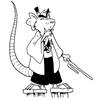
The samurai travels through various towns, triumphing over brigands, banishing obake, and restoring peace to innocent villagers lives. A skillful swordsman, his modesty endears him to everyone he meets. He is the perfect model of bushido.
Even with his long ears.
Stan Sakai’s Usagi Yojimbo, which translates to “Rabbit Bodyguard,” is the comic-book series for anyone who has ever been interested in feudal Japan. Thoroughly researched material and intriguing anthropomorphic characters have earned 48-year-old Sakai, a sansei, respect from colleagues and comic-book lovers throughout the world.
The lead character, Usagi Yojimbo, has been in his creator’s life for 17 years. The artist said that there remains much more to come. “I have so many more stories.”
Usagi Yojimbo is not based on Sakai’s own life. Although his friends tease him about putting himself into Usagi’s character, Sakai said, “It’s just speculation, I guess.” Usagi, a rabbit ronin, was instead inspired by Miyamoto Musashi, one of Sakai’s favorite characters in Hiroshi Inagaki’s Samurai Trilogy. Sakai is also a fan of Akira Kurosawa and Toshiro Mifune. Gen, the rhinoceros bounty hunter in the Usagi series, is based on Mifune.
Sakai also draws inspiration from reading. “Anything can spark an idea for a story.” he said. According to the FAQ section on the Usagi Yojimbo website, Sakai’s favorite books include Tales of Samurai Honor by Saikaku and Legends of the Samurai by Hiroaki Sato.
Japanese culture is understandably of great interest to Sakai. He was born in Kyoto in May, 1953. His father, a nisei from Hanapepe, Kauai, was in the United States Army. His mother was from Nagasaki.
When he was three years old, his family moved to Honolulu, where he attended public schools: Waikiki Elementary, Kaimuki Intermediate, and Kaimuki High. It was in high school that Sakai began to dream of becoming an artist.
Kaimuki High School Art Teacher Lorraine Kawahara encouraged Sakai to develop his artistic talent. He dedicated one of the Usagi Yojimbo collections to Kawahara. Sakai went on to the University of Hawai’i at Manoa where he received a bachelor’s degree in fine arts. Shortly after his college graduation, he moved to Los Angeles, his home for 24 years. Still a local boy at heart, he can sing Kikaida’s theme song, frequents Gina’s for plate lunches whenever he returns to Hawai’i - approximately every three years — and craves the beach.
Sakai and his wife, Sharon, plan to celebrate their 25th anniversary this year in France, where Sakai will be attending the Angouleme Comic Book Festival. He said that the trip actually serves dual professional purposes; he will be there for the festival, which was arranged by his French publisher, Paquet, as well as for an art show where he will be a featured American artist.
The adventures of Usagi Yojimbo are being translated into several different languages, including French, German, Italian, and Croatian. Coincidentally, a German publication recently requested permission to reprint “Usagi’s Garden,” which The Herald has included in this section.
Sakai understands the reasons for reprinting the story and agreed that it is a good lesson for children because Usagi is still a child himself. “This is a time that he’s still learning.”
Sakai’s efforts to help children have not gone unnoticed. He has received the Inkpot Award, a lifetime-achievement honor, the Parent’s Choice Award, three Eisner awards, and a spot on the American Library Association (ALA) list. Sakai said that the ALA honor was his favorite, because he has volunteered for the Friends of the Library in Los Angeles by offering guest presentations.
Like Usagi, Sakai is a ronin himself. The savvy Sakai owns Usagi’s character and all of his stories, and has full authority over the direction he takes with the story line. He said that it is important, in the comics business, to own the trademark and the rights to characters. He cited Superman’s creators as an example of the dangers of entrusting everything to a company: Sakai said that they were penniless for years before a news story exposed the hardships of their situation.
Sakai, who is a freelancer, works at home in a studio equipped with a radio, TV and computer. He said that writing requires a quieter atmosphere than drawing. “Writing takes a lot more energy.” when he draws, however, he said that he can have the TV or the radio blaring in the background.
The reason Sakai’s writing takes more concentration is the amount of research he has to do for his stories. “People really pay attention to the research, and if I get something wrong. I really hear about it,” he said.
In the original publication of the story “Demon Mask,” the characters play a game of Go. Soon after it was released, Sakai received tons of e-mail telling him that the characters were holding the pieces incorrectly. After purchasing books on Go and attending a Los Angeles Go tournament, Sakai immediately changed his error of the game’s piece placement in time for the corrected story to be published in a trade paperback edition.
A regular day for Sakai usually begins when he wakes up at 5:30 a.m., travels to the kitchen to make lunch for his kids, 11-year-old Hannah and 9-year-old Matthew, and starts the laundry. “I make sure Sharon and the kids go off to work and school,” he said happily.
This has been his routine for years. “When the kids were really young, I was the stay-at-home parent,” said Sakai, who has been bringing his children to comic-book conventions since they were babies — even setting up a crib at the San Diego Convention.
After doing daily chores, Sakai logs on to the Internet and surfs the World Wide Web, including the official Usagi Yojimbo site at www.usagiyojimbo.com, before beginning his work. “I like what I do and I have the discipline to do this,” Sakai said.
Sakai admitted that freelancing means working at home in isolation and explained that to combat the loneliness he and about ten of his colleagues in the cartooning business, including a few Disney artists, have met at a local cafe every Friday for the past 18 years.
One thing that doesn’t worry Sakai as much as one would think is comic-book sales. He said that movies based on comics — X-Men, the Batman films, and the upcoming Spiderman — have not exactly boosted comic-book creators’ incomes: “It made people more aware of what’s going on, but that doesn’t necessarily translate into comic book sales.” Rather, Sakai attributed the recovering comic-book market to another turn of a 20-year cycle.
Of all the stories he has published, a few stand out in Sakai’s memory as being really special. His first story, “Goblin of Adachigahara.” was what rooted the character of Usagi in the real world of Japan. “A Kite Story” is also meaningful, because it was the first time he really did research to prepare for a story.
The research he did for “Grasscutter,” his third memorable story, led to its inclusion in the curriculum of the University of Portland’s Japanese-history class. “‘Grasscutter’ is certainly the most ambitious,” he said of the tale, which begins with a fascinating account of the creation of swords.”
Although Sakai already has a successful career of his own, he continues to do the lettering for well-known comic-book artist Sergio Aragones’ Groo the Wanderer. Sakai said that they are working on a four-issue Groo story called “Death and Taxes.” Sakai and Aragones have been friends and associates for 23 years, and have been on a few trips together. Sakai laughed when he described the Hawai’i trip they took several years ago. Aragones could only enjoy paradise for a day before returning to the grind. Sakai, in the meantime, stayed longer. “He’s always working,” Sakai said of Aragones.
In contrast, Sakai enjoys a more balanced life. He said he used to do a lot of comic-book tours, but the hectic schedule became too stressful. Now he relegates touring to a once-a-month event. “I’ve been enjoying staying at home,” said Sakai, a regular Mr. Mom. “I can work at whatever pace I need to.”
Sakai’s advice to budding comic artists is to practice a lot and carry a sketchbook everywhere. He recommends students draw inspiration from life and avoid copying other comic books. He also said that taking basic art classes never hurts.
His last piece of advice is to show your work to anyone who will grant you attention. “Learn to take criticism.” advised the skillful artist with a humble disposition.
Sounds like someone else we know — except without the long ears.
HAWAII HERALD VOL. 23 #1, JANUARY 11, 2002
Moderators: Mayhem, Steve Hubbell, Moderators
-
Steve Hubbell
- Taisho
- Posts: 6052
- Joined: Thu Sep 19, 2002 15:25 -0700
- Location: Kalamazoo, MI